
What Does the Bible Say About Faith
Biblical Faith – Laying the Foundation for Understanding
Part One: Abraham, the Father of Faith
There have been a multitude of books written about faith just in the past 75 years alone, because the topic consists of an almost unlimited number of subcategories. For example, there are books answering the questions of:
- What is faith
- How to grow your faith
- How to share your faith
… and I could go on and on.
Therefore, it would be naive for the author, and even you the reader, to believe within a single article, we can thoroughly unpack the complex and deep spiritual meanings of what the Bible says about faith.
On the other hand, however, it is very possible to help the reader to lay a good foundation for your understanding of faith in a single article. How? Because the Word of God perfectly and plainly reveals the fascinating portrait of faith, when laying out for us the historical account of the life of a man named Abraham, the Father of Faith.
Therefore, in part one of this series, it is the writer’s hope to help lay a good foundation of one’s understanding of faith by sharing pieces of the historical and Biblical account of the life of Abraham.
However, before moving on, the author first wishes to make a clarification. He initially wanted to title this article, “The Basics of Christian Faith,” but quickly realized it would be misleading, because there is absolutely nothing basic about Faith. Afterall, Christ Himself is both the Author and Perfector of Faith. And though the goal is to make this teaching as pragmatic as possible in order that it can easily be understood, faith by no means is pragmatic. Neither is it easily understood at times. And yet, God has revealed it plainly to those wishing to seek His truth.
Abraham – The Father of Faith
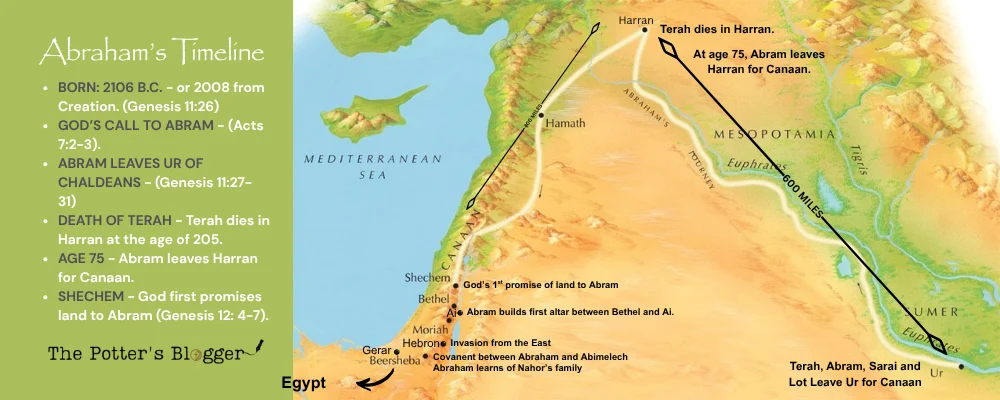
Abraham, originally named Abram before God renamed him Abraham, was born approximately 2166 B.C beyond the Euphrates River. He was the son of Terah, a man who’s people worshipped “other gods.” Nevertheless, one day the LORD had said to Abram:
“Go from your country, your people and your father’s household to the land I will show you. I will make you into a great nation, and I will bless you; I will make your name great, and you will be a blessing. I will bless those who bless you, and whoever curses you I will curse, and all peoples on earth will be blessed through you.” (Genesis 12:1-3)
So we see a man whose father and ancestors had forever worshipped “other gods” (who were not really gods at all), who one day hears a voice tell him to leave his people and father behind, and to cut himself off from everything he’d ever called home. Not only so, but God had instructed Abram to go to a foreign land that “I will show you.” And what happens next is quite stunning. At the beginning of the very next verse, Genesis 12:4, the Bible states, “So Abram went..”
Therefore, with his wife Sarai, his nephew Lot, along with his possessions and some people they had accumulated in Harran, at the age of 75 Abram set out for the land of Canaan.
God’s Promises to Abram
God made several promises to Abram at different times, during what one might refer to as, Abram’s faith-journey. We have already discussed God’s initial promise in Genesis 12:1-3. However, God makes another promise to Abram in the 12th chapter of Genesis.
Abram had arrived in the land of Canaan. As he traveled throughout, he came to the great tree of Moreh at Shechem. There, the Bible states God appeared to him and said:
- “To your offspring I will give this land.” (Genesis 12:7)
Some time later, after returning from a trip to Egypt, Abram’s people began quarreling with his nephew’s people. Both Abram and Lot’s herds, flocks and families were growing much too large to cohabit in the plot of land in which they were living. It was then Abram suggested the two separate their herds, flocks and tents in order to avoid family quarreling. After Lot’s departure, God appeared to Abram saying:
- “Look around from where you are, to the north and south, to the east and west. 15 All the land that you see I will give to you and your offspring forever. 16 I will make your offspring like the dust of the earth, so that if anyone could count the dust, then your offspring could be counted. 17 Go, walk through the length and breadth of the land, for I am giving it to you.” (Genesis 13:14b-17)
Though God made several promises to Abram concerning the inheritance to be given to his offspring and descendants, there was one subject of vital importance God never specifically mentioned during the first 10 years of Abram’s journey. It was almost as if there was an elephant in the room, and God was just waiting on Abram to finally bring the issue to the table.
As the months and years passed, Abram’s human nature had finally caught up to him, confounding his thoughts to where he could no longer reason how God would deliver on His Promise. It wasn’t that Abram doubted God’s ability to deliver, he could just no longer reason how it was possible. For, God had made the Promise to Abram and his offspring. However, Abram was now 85 years old and was yet to have a son of his own who could produce for him descendants.
Therefore, how was God going to give the Promised Land to Abram’s descendants when, at that moment, it appeared Abram would never have any? Well, the Bible states:
- “1 After this, the word of the Lord came to Abram in a vision: ‘Do not be afraid, Abram. I am your shield, your very great reward’” (or, “you will be greatly rewarded“)
- 2 But Abram said, “Sovereign Lord, what can you give me since I remain childless and the one who will inherit my estate is Eliezer of Damascus?” 3 And Abram said, “You have given me no children; so a servant in my household will be my heir.” (Genesis 15:1-3)
Before revealing God’s response, it is imperative the reader understand the significance of this conversation. For, what happens next during this interaction between God and Abram, will be one of the foundational building blocks of Christianity some 2,000 years later.
God replied,
- “This man will not be your heir, but a son who is your own flesh and blood will be your heir.” 5 He took him outside and said, “Look up at the sky and count the stars—if indeed you can count them.” Then he said to him, “So shall your offspring be.” 6 Abram believed the LORD, and he credited it to him as righteousness.” (Genesis 15:4b-6)
*words in red added by author

Abram’s Faith Credited as Righteousness
There are two things on which I wish for you to focus when it comes to God’s response to Abram in Genesis 15:4-6.
- Abram’s Response.
Firstly, God told Abram a son of his own flesh and blood would be the heir of the inheritance, and that his descendants would become as countless as the stars in the sky. And what was Abram’s response? The Bible says that “Abram believed the LORD.” And what was God’s response to Abram’s belief? God “Credited it to him as righteousness.”
Some 2,000 years later, the Apostle Paul mentions this dialect between God and Abram in his letter to the Romans:
Abram believed God. That is why God credited it to him as righteousness. It wasn’t because Abram attended Church every Sunday and small group study every Wednesday evening. It wasn’t that Abram prayed before every meal or read a chapter in his Bible every day. Though each of those practices, in and of themselves are good to have in one’s life. However, simply performing good works is not what makes one righteous in the eyes of God. No! All Abram did was believe what God had said to him. And God credited it to him as righteousness.
Brothers and Sisters, that is the bedrock meaning of faith. It is believing what God has told us and being absolutely persuaded that He has the power to do what He has promised.
- A foreshadowing of the Gospel of Jesus Christ.
Secondly, Abram found himself in a predicament when it came to he and his descendants inheriting the Promised Land. And what an opportunity this was for God to use his predicament as a means of revealing to Abram at least a glimpse of another promise. In this dialect, it is revealed there is only one way to the Promised Land of God – through a Son of which God Himself would provide. God absolutely fulfilled this promise:
- Through a miracle birth (from a 100-year-old man and his 90-year-old wife) came Abram’s son, Isaac.
- Through a miracle birth (some 2,000 years later from a young virgin woman) came the One and Only Son of God, Jesus Christ.
Abraham’s Final Test
“Now faith,” the author of Hebrews writes, “is confidence in what we hope for and assurance of what we do not see. This is what the ancients were commended for.” (Hebrews 11:1-2)
When Abram was 99 years old, God appeared to Him once more to create the Covenant of Circumcision. It was then that God would give Abram the new name, Abraham, which means Father of Many Nations. God also gave Sarai the new name, Sarah, which means Princess of the Multitude. It was also during this visit God would inform Abraham that Sarah would bore him a son the following year, and that he was to name him Isaac. God said to Abraham about Isaac, “I will establish my covenant with him as an everlasting covenant for his descendants after him.” (Genesis 17: 19b) And at the age of 100, Sarah did give birth to their son, Isaac.
Now when Isaac had grown into a young boy, the Bible says God tested Abraham, telling him to take Isaac to the land of Moriah and to sacrifice him there as a burnt offering. Faced with this odd command, Abraham set out on a 3-day trip to complete the task at hand. By all means feel free to read the whole story in the 22nd chapter of Genesis.
Wouldn’t you love to know what Abraham was thinking at that very moment? Afterall, every time we see this scene from the Bible depicted in a motion picture, we find Abraham crying and shaking as he’s about to sacrifice his son, Isaac. But is that really how it all played out? Was the Father of Faith really trembling in agony?
Though I will not give my own opinion, I will conclude this article with Biblical Scripture surrounding this sacred moment in time and let you decide for yourself.
CONCLUDING REMARKS:
Let us conclude with this:
- The author of Hebrews states the ancients such as Abraham, were commended for having confidence in what they hoped for and assurance of what they could not see.
- When Abraham was about to take Isaac up the mountain to sacrifice him to God, he said to the servants who had accompanied them on the journey, “Stay here with the donkey while I and the boy go over there. We will worship and then we will come back to you.” (Genesis 22:5) Was Abraham just trying to think positive and keep a positive attitude, or did he really believe both he and the boy would return?
Well, this is what we know about Abraham, the Father of Faith.
Abraham clung to every word and promise God had ever made to him. Not only did he cling to every word, but he believed every word. And somewhere along that 3-day journey, though Abraham was now well over 100 years old, he managed to remember a promise his God had made to him at the age of ninety-nine when God said, “I will establish my covenant with him (Isaac) as an everlasting covenant for his descendants after him.” Yet, at this moment on the mountain, Isaac was still a young boy with no children of his own.
Therefore, while on his 3-day journey to sacrifice his son to God, Abraham, the Father of Faith could only draw one single possible conclusion. Not two, but only one possible conclusion, when “Abraham reasoned that God could even raise the dead, and so in a manner of speaking he did receive Isaac back from death.” (Hebrews 11:19)
Amen.
Part 2 on faith coming soon.
Enjoy Our Latest Videos

Get the Word via inbox
Get Updates Sent Straight to Your Inbox